Causal Inference in Quantitative Pharmacology - Part I
The link between Drug Discovery & Drug Development

Data Science in R&D finds use-cases from Research and Early Development to Late Clinical Development. Non-clinical and clinical pharmacology is the crucial link between the two aforementioned fields. Drug Discovery primarily relies on in vitro data to optimise a few chemical series, it's the non-clinical pharmacology that makes sure the most efficacious and safe molecules tested in animals are advanced into the clinics. Clinical pharmacology then works with human pharmacology data to deliver effective Proof-of-concept studies, i.e. Phase II.
There's a number of scientific disciplines both non-clinical (DMPK, Tox) as well as clinical working in Pharmacology and the computational discipline that works closely with them is Pharmacometrics. The core causal relationship that needs to established in this stage of drug development is:
Dose ➡ Pharmacokinetics ➡ Pharmacodynamics
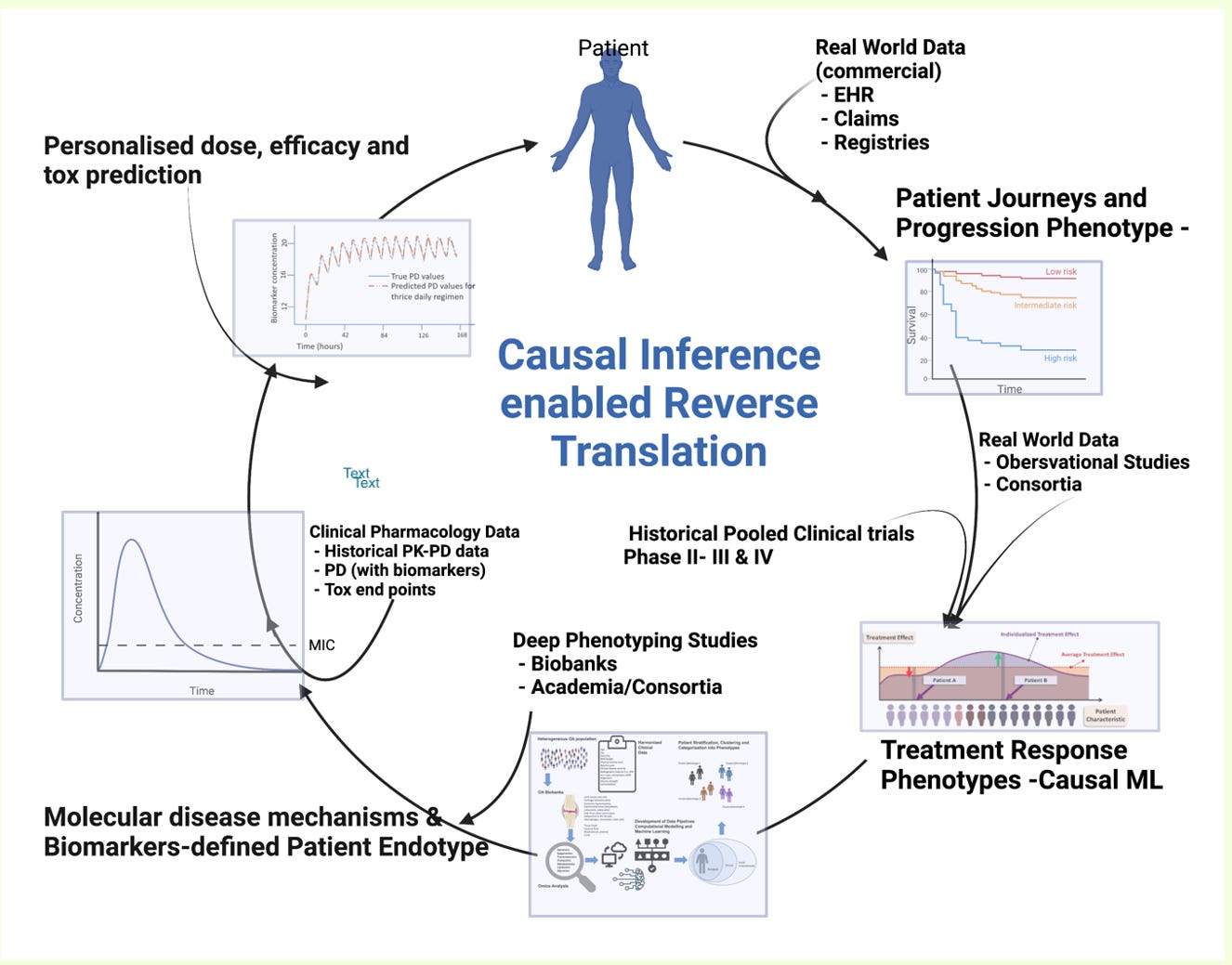
I have previously written on Causal Machine Learning in drug development where I focussed on Phase II-Phase IV applications of individual treatment effect, thus being a key enabler of stratified medicine as well as de-risking clinical decision making. The application of Causal Inference in Quantitative Pharmacology is around personalised dose, efficacy and adverse event prediction thus ensuring we're better modelling the multi-modal data which we readout from subjects in early clincal development.
For those interested in Data science use-cases in this area, a highly relevant whitepaper from cross-industry Quantiative Pharmacology departments just came out a few days ago which I highly recommend:
https://ascpt.onlinelibrary.wiley.com/doi/full/10.1002/cpt.3053